Monday, May 13, 2013

Yes, this is enough

Out in the early morning, just before the early sun climbs the mountain and reflects itself on the snow caps opposite, I bring with me a mug of tea.   Despite the panorama almost too beautiful to contemplate, I close my eyes:  the bell call of the great-tit and the soft call of the bullfinch, a hundred points of birdsong like stars all around, a woodpecker to the right and a cuckoo to the left, a cowbell from on high and a cockerel in the valley below, the gargle of crows who come and go, a visiting donkey who revs up his squeeze-organ for a honk and a holler which bridges the mountains.

Life accepts to touch down here.
Breathing returns to base
It is enough.


Old Trees

As I grow, as I grow older, I am drawn to old trees;  trees bent by prevailing winds, whitened with lichen, bits lobbed off and bits dying off, year after year roots expanding deeper, year after year opening new leaves to the sun.


Ariège Mountains; an exchange


Meet my new friends
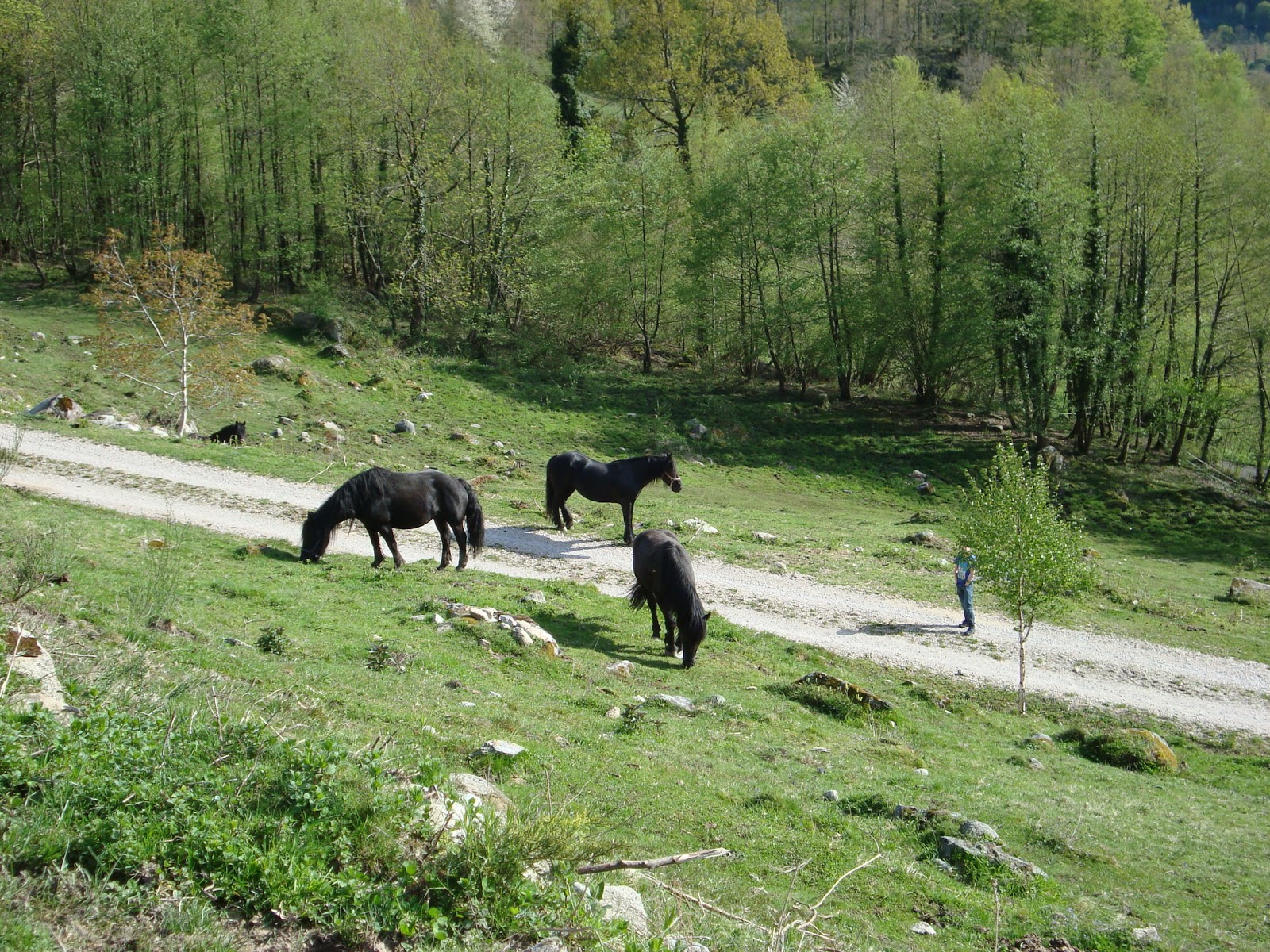
Here you can exchange your neighbours and your friends (if you have any)  for two sweet-eyed fat brown cows with bells, three fawn furry donkeys, four black Pyrenéen ponies and their newborn foal, a colony of lizards who jump for flies on the veranda windowsill, a host of birds, and a mason bee who stashes pollen balls in the hole in your front door.

You can exchange the distant roar of traffic for the distant roar of the river;  the view over the roofs with wires and satellite dishes for snow peaks and running ragged lines under a wide sky.  At night, swop the orange imposition and sad green of streetlamps for clusters of lights tucked into the mountain face in front of you where houses are hidden, and above it the slightly different dark of the wide sky, where all the stars in the cosmos alighted and hang in juicy drops, and you can go out into the night, and feel the sky fall all around you.


Actual view from our gite

Actual gite, actual weather!


B observing lizards in the panoramic veranda

Fat bottomed cows you make the rocking world go round


Whole cow:  horned and free, when she looks at you, you know you have been looked at


Posing for a still

Free range cow


...three fawn furry donkeys...


Coquette pose, look at the front legs...


...four black Pyrenéen ponies and their newborn foal...the "Cheval de Mérens" is a traditional breed from ancient times in the Ariege Pyrenees, still rare but being reintroduced, known for its hardiness, and its somewhat wild but sweet temperament.    It can be recognised among other things for its 'beard', hair growing behind its cheeks.

The whole extended family checks out the foal situation, mother and foal have been 'helped'  up the mountain to join the others 'chez eux'


I loved watching the group of horses and how they behaved together.  On the day the foal was born, the 3  grown ups  climbed up the steep mountainside and called for the mother, but the foal was too young to manage the climb.  Eventually they abandoned their calling and charged down the hill to join her (R has footage).
The foal ran in the opposite direction, here he is nuzzled back into order


...a colony of lizards who jump for flies on the veranda windowsill...


Ariege Mountain Holiday; St Girons Market

Saturday is market day, we arrive and stock up with food for the holiday, and to buy presents souvenirs and a bit of food to take home (no room in car for more, sadly).  Then on the Saturday we go home, we call in again.  A multinational gathering of ecologists, hippies, artists, musicians and generally all the people I like being with selling the food I like to eat in a town I like the look of...and so drones on about how wonderful it is...in the face of disapproving teenage son who buys pizza, sits on bench, eats pizza, declares the market, the entire region Boring and "full of Old People" and every time I approach the bench asks "When can we go?"


I usually buy one pot, this one from a profound potter with blue eyes, she is part of the souvenir

Organising the mountain flower honey

Garden produce on a plain table


East-West;  Young Lebanese musician selling his organic vegetarian Lebanese sandwiches;   sauce with special thyme from the Lebanese mountains, humous, smoked aubergine pate, salad, yoghurt sauce, goats cheese...au choix

Dutch wildman goatherder, wonderful life, wonderful cheese!

Here we bought particularly aromatic lemon verbena (verveine) for tisane...

JC even found a lovely 2nd hand bookshop run by a Northerner who stocks up in Paris, opens every day it is possible to sell, works hard but loves the work - JC bought Tin-Tin cartoons and book about Eco Houses...
Beatles music...

Bought apple juice here, gathered from hedgerows, (never shake the trees it upsets them and they won't produce next year), dry the apples a little before juicing, makes them sweet... he works as a volunteer for a charity and so has use of their juice-pressing facilities, also turns wood from his garden

R cruises with headphones, to exasperation of parents,but at least he took them off

market by the river


Bought some very good caramel sauce for pancakes, made by Ariege woman who went to Brittany to learn how to cook Brittany food, and sells it to Brittany people in Ariege who complain they can't get their food...that's business!

Orange is my kind of colour

My kind of people...

 
An American grandmother hippy chick, running a portable organic cafe with camping chairs unloaded from her van:  we had perfectly blended chick pea curry and rice and a spicy chai tea with milk, very very excellent


AM I THINKING OF MOVING HERE?   YES I AM.  AM I THINKING OF BUSKING IN RESTAURANTS FOR MY SUPPER GROWING HERBS PLUCKING FRUIT AND HANGING ROUND MARKETS SELLING THINGS FROM MY GARDEN?  YES.  AM I THINKING OF WEARING FLOWERS IN WHAT'S LEFT OF MY HAIR?   YES YES YES


Monday, April 29, 2013

Eating weeds with your salad


Herbal benefits and pockets of taste to enhance our lettuce, ingredients found growing wild or planted and growing successfully in our garden.


Dandelion flower and young leaf
Violet leaf
Wild rocket
Red sorrel
Marjoram
Mint
Baby Swiss Chard
Hyssop
Lemon Balm
Sage
Fennel

Saturday, April 27, 2013

Marks & Spencer Paris

I finally made the pilgrimage to Marks and Spencer's on the Champs Elysée, it wasn't exactly St Jacques de Compostelle...


Interestingly most of the clientelle was French,  "square shaped smart over-sixties French"  looking for something in navy and stone to drape over the folds of the older figure.  I did hear a few English voices.


Firstly, I do miss the English assistants in understated polyester shirts who sympathise with you when they only have your size in fuchsia and call a flustered younger manager to answer to the charges.  The French staff were trying, but inevitably the word 'no' tripped from their lips without qualification and they were difficult to catch, they all looked flustered, partly because the air conditioning had broken down and partly because they couldn't quite work out the clientelle (some of whom were looking dangerously overheated in the queue for the changing rooms which are too small)  and there wasn't a manager in sight.  They will not order your size (which is largely absent from the rails), you must go home and DIY on the internet.

Warning;  once in the changing room, quite the worst 'fat ugly' mirrors and lighting I've ever experienced, made me want to give up clothes shopping, go home and order Crimplene coveralls delivered in brown paper.


But I am truly outraged by the fact that there was not one pair of trousers size 16 "long" in the whole shop.  For the taller, rounded woman living in Paris, there is no hope, no long trousers, and hardly a 16 to be found, so the whole Raison d'Etre for Marks and Spencer in Paris is to do LONG trousers (which are also comfy, smart, practical, not too tight and washable).    Marks and Spencer Paris,  you gave me hope, and you took it away.

Idea for improvement?
I know what would work for me;  the entire range in every size for trying on only.  When you find the size and style that is right, you go to the counter for a human exchange where the assistants can help you order, discuss any practicalities, and generally build good customer relations and loyalty...

Thursday, April 25, 2013

Measles and Badgers

The death of someone is the death of a whole world, and the death of a child the worst of all,  unbearably painful for the loved-ones left behind.  We can't want children to die or suffer permanent damage from measles.

At the same time as the measles publicity comes news about diabetes:  drinking one can of fizzy drink a day seems to increase your risk of developing type 2 diabetes by 22 percent.  The whole history of sugar, in particular corn syrp and its mass introduction (as big as a vaccination programme) has caused untold disease, suffering and death, and the fatal addiction continues (http://www.gracelinks.org/133/film-review-king-corn).    Road traffic accidents seriously injure 200 000 people a year in the UK, kill 2,200.  The fact is many aspects of our behaviour, the conditions in which we find ourselves or the choices we make kill and maim us on a regular basis, a lot of them a result of wrong-thinking by scientists, dare I say it, or governments or epochs, and by commercial interest.  Where do we start when we want to reduce human suffering?

One pointed thinking...on the end of a needle
I guess the thing about vaccines is, it would seem to be a simple solution with no price to pay, the disease can be prevented and eradicated, just a little scratch and you're done.  That is, IF there is no deeper or wider price to pay than the little scratch, what if we are only scratching the surface of this issue?   Our information on the subject may not be totallyl unbiased:  some very big companies are making some very big money out of vaccines, and that money and the  need to keep making more money, means that these companies, sure as eggs, are spending some of that money on getting Big Access to our media world, our political world, our medical world, and our heads.

I heard on Radio 4 this morning that certain elements of yer British Public are cwoss with Doctors and have lost faith in them, because they believe them to have a vested interest in giving vaccines vis a vis a small fee which is paid to GPs for each one given.    GPs are rather hurt by this, according to the Dr interviewed.  This doctor might have shown a little more imagination, as it is undeniably true that there is commercial interest in vaccines, it's coming from behind the friendly and reassuring face of Doctor, from the companies that research, market, manufacture and distribute them, and this is big business and big business rules apply.    Is this the best way to spend society's money on researching health, reducing suffering and death?

The take on the MMR vaccines causing autism has been discredited and the last remains of possibility thoroughly ground under the heel of national publicity,  we are obviously totally stupid to have taken any notice of it, scoff scoff.  But what if Andrew Wakefield was onto something, just not exactly what he thought or could prove, because his approach was flawed? (allow Andrew Wakefield to reply and open a balanced debate by watching this http://www.youtube.com/watch?v=d7kbWfsygG4).   History illustrates that Scientific Certainty about health never lasts forever.  Firstly, even if a few pre-disposed children develop autism triggered by the vaccine, then these children also are a world in themselves;  the question of who is at risk, who should avoid the vaccine should be researched with equal zeal.    But more than that, what do we know about the proliferation of 'unexplained' degenerative diseases in 'later' life, for example?  How can we study and know the quality of life and health over a life time of every human world living on this planet?  Is it really so simple, so black and white?  I can't know from the material evidence available, the studies haven't been done, probably can't ever be, the task is too multi-faceted, too huge.

It is easy to fork out for a vaccine in a little vial, pay the company, get the protection.  It is much harder to look at the wider picture;  what makes some people more immune than others, what makes some people less vulnerable to serious complications from a disease, what is the exact nature of the disease, it's origins, it's place in the general picture, what makes it develop?  We are not merely herd animals, meriting herd immunity, we are, or at least we have the potential to be more.  As Monty Python put it in the Life of Brian, we are all individuals, more and more so, in every aspect of our being.

The Relationship between the Bug and the Being
When no other solution exists, we have to use the blunt intstrument, but what if other solutions, much more marvellous, were to exist, if we went out to find them?  What about the really interesting questions such as;  how come some people are naturally immune, or suffer less from it, what makes people suffer serious symptoms or complications, what place nutrition, pollution, mental health, spiritual nourishment, love, childhood....whole human health, the relationship between the Bug and the Being, so, so interesting...

Now, onto badgers.  Are we going to send out a team of killers, or are we going to set up a team of creative solution seekers?  
In our desperation to cut down on TB, we want to 'kill' the source - badgers as the Government erroneously sees is (the scientists consulted don't).   Well, badgers are victims of TB, there are the rats as well...and so on.  But why are our cows falling for it, why is it worse?  Could the way we raise cows cause the disease to set in, and infect the badgers?  Imagine we wipe out 70 percent of the badger population.  Do we want the badgers to build up their population afterwards and start spreading TB again?  (after all, we aren't leaving the TB immune badgers behind, we're just using a blunt culling instrument).  Or do we want them gone from Britain forever.  And if they go, will there still be TB?  Yes.  And who next?  And what are the consequences in the general ecology of wiping out a species? (don't know don't know don't know but kill anyway, panic).

Getting our relationship right with nature
I observe, and I have infinite faith in humanity when I say we have in our world an abundence of creative thinking humans who can turn their attention to nature and work with it.  And I have equal faith that Nature can offer us an abundence of solutions, if we know how to work with her.    Yes folks, we have to get our relationship right.

There is a global tendancy to see ourselves as the hapless victims of a capricious Nature, clearly a heartless killer by nature,  or to try to be the capricious and heartless killer of nature in order to control it and be its Ruler.

Nature has the potential to be a horrific killer,has been in the past, and is also the undisputed basis for our physical existence, an abundent wealth of possibilities.  Here we need Discernment;  in our epoch, nature unheeded, unthought out, neglected and abused,  is a totally different thing from nature observed lovingly and respectfully without commercial bias,   thought about attentively and intelligently, and worked with co-operatively.  And who does all this?  Humanity.

We are beginning to understand (those of us who care to look at ecology and so on)  that it functions as a whole system, and can be balanced, or not.    You can't kill of bits of it without causing shifts and holes and reactions in the whole thing.   For examples of the extraordinary success which happens when genuinely free from vested interest agroecology turns its great mind to real solutions for feeding the world:  see what happens when Agroecologists think out solutions for areas where natural disasters are the norm, seeking out nature's own solution and putting it into practice (Harvest of the Future film by Marie Monique Robin) rather than 'killing' off the 'bad' bits (the Monstanto Global Disaster Programme).  This is THE film for our future, virtually impossible to hear about it in English, but this site works http://zero-games.ru/video/Les-Moissons-Du-Futur.html

So if we get our relationship right with Nature, how will this help us with Measles and Badgers?